As a flat carrier tapes supplier who’s worked in this manufacturing niche for over a decade, I get asked the same question at industry trade shows, on customer support calls, and even by new engineers just starting out in electronics assembly: “What’s the transparency of flat carrier tapes, anyway?” It’s a deceptively simple question, and one that trips up a lot of folks who are used to picking packaging materials based on generic “clear” or “opaque” labels. The answer isn’t a single number—it’s a balance of material choice, manufacturing process, and end-use requirements, and understanding that balance is what separates a component packaging design that works from one that causes costly production hiccups. Flat Carrier Tapes

Let’s start with the basics: flat carrier tapes are the long, flexible strips with evenly spaced pockets that hold surface-mount components (resistors, capacitors, ICs) during automated assembly. Their transparency refers to how much visible or ultraviolet (UV) light passes through their plastic film, measured using a scale called transmittance, usually expressed as a percentage. But here’s the catch—transparency isn’t universal. A carrier tape that’s highly transparent for one application might be completely unsuitable for another, and that’s where most first-time buyers go wrong.
First, let’s break down the two core materials used in flat carrier tapes, because they’re the biggest drivers of transparency: polystyrene (PS) and polycarbonate (PC). PS is the more common material for high-volume, low-cost parts like passive components. Standard general-purpose polystyrene (GPPS) has a visible light transmittance of around 88% to 92%—that’s almost as clear as a standard drinking glass. But it’s not perfect. PS is prone to yellowing when exposed to heat, UV light, or even long-term storage, which drops its transmittance over time. For applications where the tape might sit in a warehouse for 6 months or more before use, that 4% or 5% drop can turn a highly transparent tape into one that’s too dim for inspection.
Polycarbonate, on the other hand, is the workhorse for high-performance components. It has a baseline visible light transmittance of 85% to 90%, but it’s far more stable than PS. PC resists yellowing from heat and UV exposure, so its transmittance stays consistent for years. That stability is why most semiconductor manufacturers specify PC carrier tapes for integrated circuits and other delicate parts. But PC is also more expensive than PS, so it’s not the right choice for every job.
Then there’s a third, less talked-about category: amber-colored flat carrier tapes, which are almost fully opaque to visible light, with less than 5% transmittance. Wait, why would a packaging material be opaque? For components that are light-sensitive—like photodiodes, LED chips, or certain types of sensors. Exposing these parts to even a few hours of visible or UV light can degrade their performance, shifting their electrical parameters or ruining their ability to detect light. Amber carrier tapes block up to 99% of UV light and most visible light, so they keep sensitive components safe during storage and transport. A lot of new engineers I talk to are surprised by this—they assume more transparency is better, but here, transparency is a flaw.
But transparency isn’t just about visible light. For automated assembly lines, where pick-and-place robots pull components out of the carrier tape’s pockets, you also need to consider UV transmittance. Most pick-and-place machines use UV sensors to align the pockets, so even a tape that’s clear to the human eye might block UV light enough to cause alignment errors. That’s why we test every batch of carrier tapes we produce for both visible and UV transmittance. For PS tapes, we add a small amount of UV stabilizer during manufacturing to maintain UV transmittance at around 70%—enough for sensors to pick up the pocket edges, but not so much that it causes yellowing. For PC tapes, that number is even more consistent, usually around 75% to 80% UV transmittance.
Another factor that affects transparency is the thickness of the carrier tape film. Standard carrier tapes are between 0.12mm and 0.25mm thick. Thinner films have higher transmittance—for example, a 0.12mm PS tape might have 91% visible transmittance, while a 0.25mm PS tape of the same material drops to 88%. It’s a small difference, but for applications where every micron matters, that 3% can be the line between a sensor that reads the pocket correctly and one that misaligns, leading to wasted components and downtime. We always adjust thickness based on the component’s weight too—heavier parts need thicker tapes to prevent pocket stretching, so we have to balance strength with transparency for each custom order.
I’ve seen firsthand what happens when transparency is overlooked. A few years back, we had a customer who ordered 10,000 reels of PS carrier tapes for a batch of surface-mount resistors. They used standard clear PS, assuming it would work, but their pick-and-place machines’ UV sensors couldn’t pick up the pocket edges consistently. The result was a 12% error rate during assembly, which cost them over $50,000 in reworked boards and lost production time. When they came back to us, we recommended a PS tape with a modified UV stabilizer, adjusted the film thickness, and fixed the issue in 2 weeks. That’s the kind of problem that makes you realize transparency isn’t a cosmetic detail—it’s a core functional property of carrier tapes.
There’s also the difference between transmittance and clarity, which is another common point of confusion. A tape can have high transmittance (most light passes through) but be hazy, which scatters light. Haze is measured separately, and it’s critical for visual inspection. If a tape is hazy, quality control teams can’t easily spot damaged components inside the pockets, even if most light passes through. PS tapes, especially lower-quality ones, often have higher haze (around 2% to 5%) because of their manufacturing process, while PC tapes have much lower haze (less than 1%), making them better for manual or visual inspections where operators are checking each reel by eye.
So, when a customer asks about the transparency of flat carrier tapes, our first question isn’t “how transparent do you want it?” It’s “what are you packaging, and how are you using the tape?” If they’re shipping resistors for a high-volume, low-cost line, standard PS with 88% to 92% visible transmittance and 70% UV transmittance is perfect. If they’re packaging ICs or LEDs that need stability, PC tapes with 85% to 90% visible transmittance and 75% UV transmittance are the way to go. If they’re working with light-sensitive photodiodes, amber tapes with <5% transmittance are the right choice, even though they’re “less transparent.”
We also work with customers to create custom blends if standard materials don’t fit. For example, a medical device manufacturer we supply needed a carrier tape that was transparent enough for visual inspection but stable enough to withstand sterilization processes. We developed a modified PS blend with UV stabilizers that maintains 90% transmittance after gamma sterilization, which is a huge improvement over standard PS that yellows after one sterilization cycle. That’s the kind of tailored solution only a supplier with deep manufacturing experience can provide, not just a generic catalog item.
Another point worth mentioning: transparency affects storage life. As I said earlier, PS yellows over time, which reduces transmittance. We test our PS tapes’ transmittance after 12 months of accelerated aging (simulating 2 years of warehouse storage) to make sure it doesn’t drop below 85%. If a customer is storing reels for a long time, we recommend our stabilized PS or PC tapes, which hold their transparency far better. For amber tapes, the low transmittance is permanent, so they’re ideal for long-term storage of light-sensitive parts.
I’ve talked to a lot of suppliers who treat transparency as a afterthought, just a checkbox on a material spec sheet. But from where I stand, it’s one of the most important properties of a flat carrier tape. It impacts assembly efficiency, component safety, quality control, and long-term storage. Too many times, a customer cuts corners on material choice to save a few cents per reel, only to end up with bigger costs from production errors.
At the end of the day, there’s no one-size-fits-all answer to what the transparency of flat carrier tapes is. It’s a range, dependent on material, thickness, additives, and end use. That’s why it’s so important to partner with a supplier who doesn’t just sell you a tape, but can walk through your requirements, test samples, and make recommendations based on years of hands-on experience. Whether you’re packaging tiny resistors, delicate ICs, or light-sensitive sensors, we can create a flat carrier tape with the exact transparency properties you need to keep your line running smoothly.
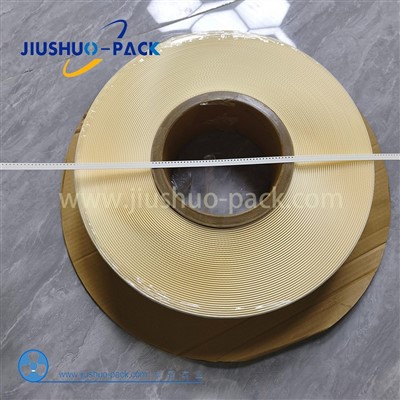
If you’re looking to source flat carrier tapes for your next project, we’re here to help. Reach out to our team to discuss your specific requirements, and we’ll provide tailored solutions and sample materials to test for your assembly process.
Reel and Tape Packaging Machine References
- "Handbook of Plastic Materials and Technology," Wiley, 2019.
- "Surface Mount Technology: Principles, Materials, and Process," McGraw-Hill, 2021.
- International Standard IPC-TM-650, Test Method 2.1.1, Transparency of Packaging Materials for Electronic Components, 2020.
- "Polycarbonate vs. Polystyrene for Electronic Packaging: Performance and Applications," Journal of Electronic Materials, Vol. 48, No. 7, 2019.
- "Light Sensitivity in Electronic Components: Packaging Requirements and Testing," Electronics Packaging and Production, 2022.
Dongguan Jiushuo Industrial Co., Ltd.
As one of the most professional flat carrier tapes manufacturers and suppliers in China, we also support customized service. Please feel free to buy high quality flat carrier tapes made in China here from our factory. Contact us for more details.
Address: 11th Floor, Building 2, Chuangfu Center, Chashan Town, Dongguan City, Guangdong Province, China
E-mail: sales06@zaidaiw.com
WebSite: https://www.carriertape-pack.com/
