If you’ve ever shopped around for a PMMA/PC pipe making machine, you know that the main extruder gets all the hype. Sales reps will rattle off specs about die size, motor horsepower, and output rate, and that’s important—don’t get me wrong. But here’s the thing: I’ve been supplying these lines for over 12 years, and I can’t tell you how many times a customer will show up with a shiny new extruder, only to find half the auxiliary gear they need is missing. Suddenly, their line is half-built, they’re scrambling to source parts last minute, and that “on-time start-up” they were promised is looking more like a holiday in the parking lot. Today, let’s break down exactly what auxiliary equipment you actually need to turn raw PMMA or PC resin into consistent, high-quality pipe—no fluff, no overpriced add-ons, just what works. PMMA PC Pipe Making Machine

First up, and maybe the most overlooked piece if you’re working with pellets straight out of the bag, is the material drying system. PMMA (acrylic) and PC (polycarbonate) are hygroscopic, which means they suck moisture out of the air like a sponge. If you feed that damp resin into the extruder, you’ll get a mess of bubbles, splay marks, and weak, brittle pipe that’ll crack the second someone bends it during installation. I’ve seen customers cut corners here, grabbing a cheap box dryer that only hits 150°F—big mistake. PMMA needs to get down to under 0.02% moisture, and PC needs to get even drier, like under 0.015%. That means you need a desiccant dryer, not a convection box dryer. Desiccant dryers use dry air that circulates through the resin hopper, pulling moisture out, and most modern ones have a dew point display so you can actually verify it’s doing its job. Skip the cheap ones—spend a little extra here and you’ll avoid rework and scrap that eats into your profits. Pro tip: If you’re running smaller batches, a mini desiccant dryer works, but for high-volume runs (like 500+ kg/h), you’ll want a dual-tower dryer so you don’t have to shut down to recharge the desiccant.
Next, the gravimetric blender. You might think you can just toss a 50/50 mix of clear PC and a tiny bit of UV stabilizer into the hopper and call it a day—but that’s a fast track to inconsistent color, weak spots, or pipe that yellows in a year. Gravimetric blenders weigh each component (resin, additives, color masterbatch) individually as they feed into the extruder, so you get precise, repeatable ratios every single time. Volumetric blenders are cheaper, sure, but they drift over time as hoppers wear or motors slip—you’ll end up with a batch that’s 2% too much masterbatch, making the pipe cloudy, then another that’s 1% too little, and suddenly your quality control team is spending all day rejecting parts. I always recommend gravimetric, even for small operations. It pays for itself in less than a year by cutting scrap and reducing material waste.
Once the resin is melted and pushed through the die, you need to cool it fast and evenly, right? That’s where the calibration and cooling system comes in. For small to medium diameter pipes (under 150mm), vacuum calibration is the way to go. The pipe is pulled through a hollow calibration sleeve, and vacuum holes along the sleeve suck the pipe tight against the inside wall, holding its shape exactly as it comes out of the die. If you skip vacuum calibration and just use air or a water tank, you’ll get a pipe that’s oval, has inconsistent wall thickness, and will twist when you cut it. For larger diameter pipes, you might use a mandrel calibration system, but vacuum is standard for most PMMA/PC lines. After the calibration unit, you need a multi-stage cooling tank—usually 2 or 3 sections, each with slightly cooler water. You don’t want to dunk a 200°C pipe straight into 15°C water, that’ll cause thermal stress and cracking. Gradual cooling keeps the pipe dimensionally stable and stress-free. Also, don’t forget the water temperature controller for the cooling tank. If the water temp fluctuates more than 1°C, the pipe’s outer diameter will bounce around, which is a nightmare for fitting compatibility later.
Now, you’ve got a long, hot pipe coming out of the cooling tank—you need to pull it at a steady rate, right? That’s the haul-off unit, and it’s not just a conveyor belt. For PMMA and PC, you need a haul-off with rubber belts that have enough grip to pull the pipe without slipping, but not so much grip that it dents or scratches the soft, still-warm pipe surface. A variable-speed drive is non-negotiable here too. The haul-off speed has to be synced exactly to the extruder output—too fast and you’ll get thin walls, too slow and you’ll end up with a pile of droopy, overcooled pipe that’s useless. Most good haul-offs let you sync with the extruder automatically, which takes the guesswork out of it. Skip the old manual ones that need you to adjust a knob every 5 minutes—you’ll get inconsistent pipe and waste a ton of time.
Once the pipe is pulled and cooled, you need to cut it to length accurately. For small to medium runs, a planetary cutter is the standard. It spins around the pipe, cutting with multiple blades at once, so you get a clean, smooth cut without any burrs. If you use a hot knife or a band saw, you’ll get rough edges, and PC is especially prone to chipping. For larger pipes, there’s also a flying cutter that cuts while the haul-off is moving, which is good for high-volume production, but planetary is more than enough for most operations. Pro tip: Make sure the cutter has a length sensor that stops it at exactly your desired size—no more guessing how long each cut is, especially when you’re running 100m rolls or 6m sticks. If you’re making coiled pipe, you’ll also need a coiler unit, which winds the cut pipe onto a spool neatly so it doesn’t kink. Coiling PMMA/PC pipe is trickier than PVC because it’s stiffer, so you need a coiler with adjustable tension and a way to guide the pipe evenly onto the spool. I’ve seen cheap coilers bend the pipe too tight, causing cracks that don’t show up until a customer installs it—total nightmare for warranty claims.
Wait, there’s one more piece a lot of people miss: the auxiliary control cabinet. No, not the main extruder control—this is a separate panel that controls all the auxiliary equipment: the dryer, blender, vacuum calibration, haul-off, and cutter. If all these pieces have their own separate controls, you’ll have to adjust 5 different panels just to change the line speed, and that leads to mistakes. A centralized auxiliary control cabinet lets you monitor all parts of the line in one place: dryer dew point, cooling tank temp, haul-off speed, cutter length, everything. It also lets you set recipes for different pipe sizes or grades—one tap for 50mm clear PC pipe, another for 100mm UV-stabilized PMMA pipe. That saves so much time when switching between jobs, which is a huge deal if you run multiple products.
Now, let’s talk about the stuff you don’t need. I know some sales guys will try to upsell you on a “state-of-the-art” particle sizer or a fancy online thickness gauge, but unless you’re running 24/7 for a big customer like a plumbing company, that’s overkill. A manual caliper and a micrometer will catch most thickness issues, and they cost a fraction of those fancy sensors. The same goes for overpriced optional die heads—unless you’re making 10 different pipe sizes every day, stick to a standard die that fits your main runs.
Here’s the bottom line I’ve learned over the years: the best pipe lines aren’t the ones with the fanciest main extruder. They’re the ones where every auxiliary piece works in sync, no gaps, no cheap shortcuts, all sized for your actual production needs. I’ve had customers come to me after a bad experience with a line they bought from a guy who only sold extruders, and they’re shocked how much difference good auxiliary gear makes. They’re not just “add-ons”—they’re the reason your pipe is consistent, high-quality, and doesn’t waste half your material on scrap.
If you’re in the market for a PMMA or PC pipe line, don’t waste time guessing which aux gear you need. I’ve helped dozens of small to mid-sized operations put together lines that start up on time, run smooth, and make pipe that their customers actually trust. Whether you’re just starting out and need a basic line, or expanding and need a high-volume setup, I can walk you through exactly what fits your budget and your product goals. Hit me up to chat through your specific needs, no sales pitch, just real advice from someone who’s been doing this for way too long and doesn’t want to see you make the same mistakes I’ve seen hundreds of others make.
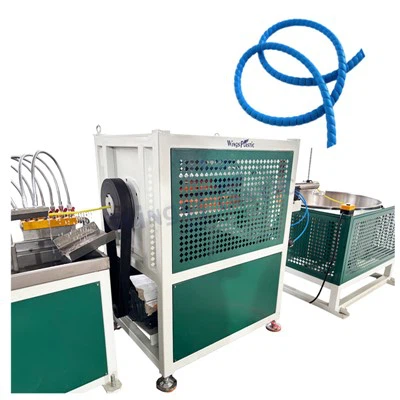
Plastic Spiral Protector Machine References:
- Modern Plastics Handbook, 7th Edition, Hanser Publications, 2019
- Extrusion Auxiliary Equipment: Design and Operation, Society of Plastics Engineers, 2021
- PMMA and PC Processing Guidelines, American Chemistry Council, 2020
Qingdao Wings Plastic Technology Co., Ltd.
As one of the most experienced pmma pc pipe making machine manufacturers and suppliers in China, we also support customized service. Please feel free to buy durable pmma pc pipe making machine made in China here from our factory. For price consultation, contact us.
Address: C02 Of Anshengyi Road, No.2 Fuan Industry Zone,Jiaodong Town, Jiaozhou City, Qingdao City, Shandong Province,China
E-mail: kelly@wingsplastic.com
WebSite: https://www.wingsextruder.com/
